Showing posts with label children's literature. Show all posts

Jan 25, 2007

Xtreme "Little House"

littlehouse4littlehouse3


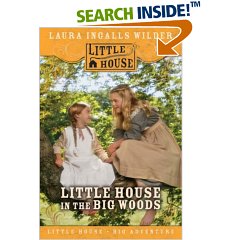
The publisher of the "Little House" series is ditching the old cover art and replacing it with pictures of models posing as the characters in the series.
"Girls might feel the Garth Williams art is too old-fashioned," says Tara Weikum, executive editor for the "Little House" series. "We wanted to convey the fact that these are action-packed. There were dust storms and locusts. And they had to build a cabin from scratch." (The new tag line: "Little House, Big Adventure.")

Publishers are altering cover art—often tied to anniversaries and movies—to appeal to kids weaned on videos and computer games. The thinking is that children are more likely to pick up "Charlotte's Web" with Dakota Fanning on it than with Williams's illustration of a girl and a pig, or Newbery winner "Bridge to Terabithia" with a scene from the Disney movie (in theaters next month). "A Wrinkle in Time" is getting two different new covers. "Purists are often upset. But this is also a way for publishers ... to beef up sales," says Diane Roback, children's editor for Publishers Weekly. "The book jackets we as adults are accustomed to seeing, and love from our childhood, may look musty and dusty to today's kids." Allison Edheimer, 9, wants the photo version of the "Little House" series. "I'd rather read something where I can picture the person," she says. Rachael Ross, 10, agrees: "I like seeing real people better than drawings," she says. "Drawings look sort of fake."
Kids these days.

I always liked the cover art because it was old-fashioned--it seemed to promise an entry into a different world. The new covers make it look as though the books are a tie in to an after-school special. Of course, it could be worse: The covers could feature scenes from the old TV show, which was an abomination.

Dec 26, 2006

For children of all ages

Ursula Le Guin discusses fantasy in children's literature.
Lewis Carroll wrote to and for the child, with no winks and sniggers over her shoulder at the grown-ups. He clearly took pleasure in making the story equally absorbing for Charles Dodgson, the professor of mathematics, and for any adult who was ready to appreciate his jokes, tricks, politics and chess moves, his half-hidden intellectual game-playing. But the important thing is that the naivety of his audience did not lead him to withhold emotional investment in the story, to "write down". On the contrary, writing for a child while keeping to a strict standard of emotional honesty seems to have freed him from facetious or merely allegorical Victorian moulds, to find an inexplicit but radically vivid imagery with which to explore the intersections of reality and dream. The same is true of George MacDonald, whose fantasies for children are deeper and stranger, I think, than those he wrote for adults.

It is the strict standard of emotional honesty that counts. This is where Oscar Wilde's fairy tales fail, and sometimes Hans Christian Andersen's. They only pretend to be for children. Disguising adult self-pity in sentimental cruelty is an unfortunately effective ploy. Andersen's tales fascinated and frightened me as a child; I read them only when I already felt morbid. But the Pan chapter of The Wind in the Willows I loved dearly even when I only half understood it, for its emotional exaltation is genuine.
This really struck a chord for me. I remember the Pan scene in Wind in the Willows vividly; I remember first reading it as a child and I remember reading it to my child.

By contrast, I remember reading Andersen's "Little Match Girl" and "The Red Shoes," while staying at an aunt's house and being repelled by the stories. The "Little Match Girl" freezes to death on a street corner while dreaming about a Christmas feast.

Ratty and Mole have a much more satisfying Christmas experience.
The weary Mole also was glad to turn in without delay, and soon had his head on his pillow, in great joy and contentment. But ere he closed his eyes he let them wander round his old room, mellow in the glow of the firelight that played or rested on familiar and friendly things which had long been unconsciously a part of him, and now smilingly received him back, without rancour. He was now in just the frame of mind that the tactful Rat had quietly worked to bring about in him. He saw clearly how plain and simple— how narrow, even— it all was; but clearly, too, how much it all meant to him, and the special value of some such anchorage in one's existence. He did not at all want to abandon the new life and its splendid spaces, to turn his back on sun and air and all they offered him and creep home and stay there; the upper world was all too strong, it called to him still, even down there, and he knew he must return to the larger stage. But it was good to think he had this to come back to; this place which was all his own, these things which were so glad to see him again and could always be counted upon for the same simple welcome.