If you're a 9- or 10-year-old at the P.S. 29 elementary school in Brooklyn, N.Y., you've got more pressing concerns: Dragons. Monsters. Big waves at the beach that might separate a girl from her mother. Thirty years ago, quicksand might have sprung up at recess, in pools of discolored asphalt or the dusty corners of the sandbox—step in the wrong place, and you'd die. But not anymore, a boy named Zayd tells me. "I think people used to be afraid of it," he says. His classmates nod. "It was before we were born," explains Owen. "Maybe it will come back one day."
Hmmm. I remember being afraid of quicksand. Also, improbably, tsetse flies, thanks to a neighbor kid's mother who assured us that there had been an influx of the creatures one summer. She warned us not to go to sleep if we got bitten, or we'd never wake up. I spent many a long night that summer trying to stay awake, afraid that one of the mosquito bites on my legs was really the work of a tsetse fly.
I wasted a perfectly good dose of insomnia last night watching Atonement, yet another period piece starring Keira Knightley, animated coat rack. It is long. It is pretentious and it's boring as all get out. It also failed to cure my insomnia as I was up a good hour after the movie was over.
As is my wont, after it was all over I looked up reviews to see what the critics had to say about this particular cinematic endeavor. Only one came close to being as unenthusiastic as I was. The rest were in raptures. Raptures. Particularly over a single, long-winded shot of the Dunkirk evacuation that went on for about five minutes, but felt like five hours. I particularly detest these bravura gestures that do nothing to advance the plot or help us understand the characters but show what visual geniuses the director and cinematographer are. Yes, James McAvoy (SPOILER ALERT) dies before he's evacuated, but they could have killed him off so much faster.
As Elaine Benes of Seinfeld so succinctly put it when discussing an equally boring, pretentious and long-winded romance: "Die already!"
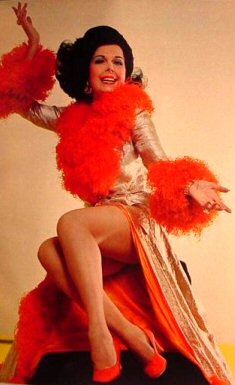
The dancing sensation, who died in 2004, was born April 12, 1923. She started working as a dancer at age 14 after her mother moved her to LA to escape a bad marriage. Like other actresses of her time--Ginger Rogers and Bette Davis come to mind--Ann supported her mother whose hearing impairment made it impossible for her to work.
TCM aired a 1997 interview yesterday that Miller did Robert Osborne in which she discussed her long career. Among the highlights: She invented pantyhose. Miller complained to a hosiery maker that she had to have her silk stockings sewn to her dress and undergarments for every costume change. If she got a run in her stockings, they'd have to rip everything apart and sew on a new one. "Why can't we have what ballet dancers have but with silk stockings?"
She married three times, unsuccessfully. Her first marriage at 18 was particularly awful. Miller reneged on her contract with Columbia "to become a housewife" to millionaire Reese Milner. He beat her many times, the last time when she was almost nine months pregnant.
Columbia wouldn't take her back so she auditioned for the part of Fred Astaire's former dancing partner for the movie Easter Parade. On the movie she choreographed and performed "Shaking the Blues Away," a showstopper that set the tone for most of her solos. And she did it wearing a metal brace on her back, a vestige of the beating that ended her marriage and caused the death of her only child.
Miller never became a leading lady; she was always the second lead. But she did get to do some incredible numbers to show case those incredible legs.
After the big musical went the way of the big studio, Miller appeared in numerous TV shows and had a nightclub act. And she kept dancing. Here's a commercial she did for Campbell's soup in 1970.
Fabulous, is it not?
At the age of 56, Miller teamed with Mickey Rooney for the show Sugarbabies, a smash hit on Broadway that saw her dancing again.
"At MGM, I always played the second feminine lead; I was never the star in films," Miller once said.
"I was the brassy, good-hearted showgirl. I never really had my big moment on the screen.
"Sugar Babies gave me the stardom that my soul kind of yearned for."
Miller stayed with the show for nine years.
Ann Miller returned to movies in the 2001 David Lynch flim, Mulholland Dr still wearing her trademark raven hair and red lipstick.
After years of refusing film offers because she hated the nudity and violence that had become almost a cliché in contemporary pictures, she went to work with one of the screen's most controversial directors, David Lynch, with a double role in Mulholland Dr. (2001), a film featuring both nudity and graphic violence. Of course, that wasn't what she had signed on for originally. The project was planned as a TV series for ABC, with Miller playing the eccentric landlady at a Hollywood apartment complex. When the network passed on the pilot, Lynch found funding for additional scenes and turned it into a feature. Miller's part became a double role. Her surprise appearance as a Hollywood hostess at the end gave fans a last look at their favorite and an inkling of what she could have done had she had time for more non-musical roles.
He wore green tights and a little hat, swung from trees, tossed his head back for bellowing laughs, and made grand speeches, and did it all without looking silly or effeminate.
Strictly speaking the summer blockbuster was born in 1975 with the release of Jaws. But The Adventures of Robin Hood which opened in May 1938--the beginning of the modern day summer movie season--fits the formula: It was the studio's first foray into "glorious technicolor" and at a cost of $2 million, was the most expensive movie in the history of Warner Brothers. Originally the part of Robin was supposed to go to Jimmy Cagney, but Cagney was in the middle of a contract dispute and walked off the set. Producer Hal Wallis decided the sets, scenery and story would draw audiences no matter who played the hero so he decided to cast newcomer Errol Flynn.
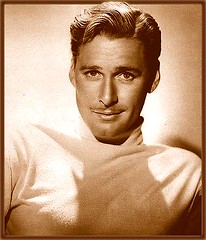
The original man in tights, Errol Flynn became the king of the swashbuckler and the prototype for the action hero of today. When Flynn had his first star turn, in the 1935 movie Captain Blood, the reviewer for the New York Times noted that the actor playing the hero was "criminally good-looking" and praised his audacious performance. Flynn's portrayal of Sir Robin of Locksley cemented his status as a superstar.
Handsome, athletic and charming, Flynn was beloved by men, women and children, which is really the prerequisite for a classic man of summer. Men want to hang out with him, women want to be with him and children want to be like him.
He was improbably handsome, but that wasn't really the point: What made him a star was his lighthearted exuberance, the good cheer with which he embodies a role like Robin Hood. When George C. Scott was asked what he looked for in an actor, he mentioned "joy of performance," and Flynn embodies that with a careless rapture. Watch his swagger as he enters John's banquet hall and throws a deer down before the prince, full knowing that the punishment for poaching a deer is death. Surrounded by his enemies, he fearlessly accuses John of treason against his brother Richard the Lionhearted, and then fights his way out of the castle again. Another actor might have wanted to project a sense of uncertainty, or resolve, or danger; Flynn shows us a Robin Hood so supremely alive that the whole adventure is a lark. Yes, his eyes shift to note that the exit is being barred and guards are readying their swords, but he observes not in fear but in anticipation.
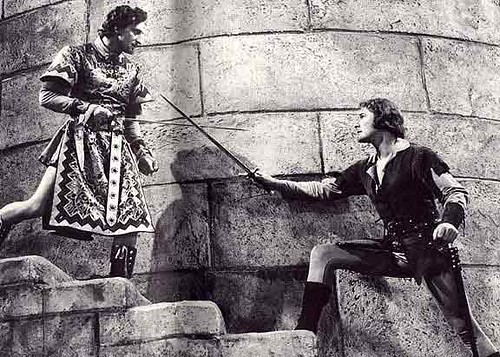
Before car chases, computer animation or light sabers, the sword fight was the action hero's forte and Flynn performed some of the silver screen's finest duels. Although he occasionally used a stunt double, much of the swordplay was performed by Flynn, who studied fencing in earnest to prepare for the role. Here's Robin Hood dueling with Sir Guy of Guisbourne, played by Basil Rathbone. The scene was said to be the inspiration for the light saber duel between Luke Skywalker and Darth Vader in The Empire Strikes Back.
Rathbone and Flynn went on to face off against each other in a string of movies with similar plots. sort of like the sequels that are inevitable when a summer action flick becomes a true blockbuster.
The rules: Bold movies you have watched and liked. Turn red movies you have watched and loved. Italicize movies you saw and didn’t like. Leave as is movies you haven’t seen. AND, since Sheila added the RED, I'll use blue for movies I saw but don't give a fig about one way or the other.
The Godfather (1972) The Shawshank Redemption (1994) The Godfather: Part II (1974) The Good, the Bad and the Ugly (1966) Pulp Fiction (1994) Schindler’s List (1993) Star Wars: Episode V - The Empire Strikes Back (1980) One Flew Over the Cuckoo’s Nest (1975) Casablanca (1942) The Lord of the Rings: The Return of the King (2003) Star Wars (1977) 12 Angry Men (1957) Rear Window (1954) No Country for Old Men (2007) Goodfellas (1990) Raiders of the Lost Ark (1981) The Lord of the Rings: The Fellowship of the Ring (2001) City of God (2002) Once Upon a Time in the West (1968) The Usual Suspects (1995) Psycho (1960) Dr. Strangelove or: How I Learned to Stop Worrying and Love the Bomb (1964) Citizen Kane (1941) The Silence of the Lambs (1991) North by Northwest (1959) The Lord of the Rings: The Two Towers (2002) Fight Club (1999 Memento (2000)) Sunset Blvd. (1950) Lawrence of Arabia (1962) It’s a Wonderful Life (1946) The Matrix (1999) Taxi Driver (1976) Se7en (1995) Apocalypse Now (1979) American Beauty (1999) Vertigo (1958) Amélie (2001) The Departed (2006) Paths of Glory (1957) American History X (1998) To Kill a Mockingbird (1962) Chinatown (1974) Eternal Sunshine of the Spotless Mind (2004) The Third Man (1949) A Clockwork Orange (1971) Pan’s Labyrinth (2006) The Treasure of the Sierra Madre (1948) Alien (1979) The Pianist (2002) The Shining (1980) Double Indemnity (1944) L.A. Confidential (1997) Leben der Anderen, Das [The Lives of Others] (2006) The Bridge on the River Kwai (1957) Boot, Das (1981) The Maltese Falcon (1941) Saving Private Ryan (1998) Reservoir Dogs (1992) Forrest Gump (1994) Metropolis (1927) Aliens (1986) Raging Bull (1980) Rashômon (1950) Singin’ in the Rain (1952) Rebecca (1940) Hotel Rwanda (2004) Sin City (2005) Terminator 2: Judgment Day (1991) All About Eve (1950) Modern Times (1936) Some Like It Hot (1959) 2001: A Space Odyssey (1968) The Seventh Seal (1957) The Great Escape (1963) Amadeus (1984) On the Waterfront (1954) Touch of Evil (1958) The Elephant Man (1980) The Prestige (2006) Vita è bella, La [Life Is Beautiful] (1997) Jaws (1975) The Manchurian Candidate (1962) The Sting (1973) Strangers on a Train (1951) Full Metal Jacket (1987) The Apartment (1960) City Lights (1931) Braveheart (1995) Cinema Paradiso (1988) Batman Begins (2005) The Big Sleep (1946) Mr. Smith Goes to Washington (1939) Once Upon a Time in America (1984) Blade Runner (1982) The Great Dictator (1940) The Wizard of Oz (1939) Notorious (1946) Salaire de la peur, Le [The Wages of Fear](1953) High Noon (1952) Star Wars: Episode VI - Return of the Jedi (1983) Fargo (1996) The Bourne Ultimatum (2007) Unforgiven (1992) Back to the Future (1985) Ran (1985) Oldboy (2003) Million Dollar Baby (2004) Cool Hand Luke (1967) Kill Bill: Vol. 1 (2003) Donnie Darko (2001) Indiana Jones and the Last Crusade (1989) The Green Mile (1999) Annie Hall (1977) Kind Hearts and Coronets (1949) Gladiator (2000) The Sixth Sense (1999) Diaboliques, Les [The Devils] (1955) Ben-Hur (1959) It Happened One Night (1934) The Deer Hunter (1978) Life of Brian (1979) Die Hard (1988) The General (1927) American Gangster (2007) Platoon (1986) V for Vendetta (2005) Judgment at Nuremberg (1961) The Graduate (1967) The Princess Bride (1987) Crash (2004/I) The Wild Bunch (1969) Butch Cassidy and the Sundance Kid (1969) Letters from Iwo Jima (2006) Heat (1995) Gandhi (1982) Harvey (1950) The Night of the Hunter (1955) The African Queen (1951) Stand by Me (1986) Kill Bill: Vol. 2 (2004) Witness for the Prosecution (1957) The Big Lebowski (1998) The Conversation (1974) Little Miss Sunshine (2006) Wo hu cang long [Crouching Tiger, Hidden Dragon ] (2000) The Grapes of Wrath (1940) Gone with the Wind (1939) 3:10 to Yuma (2007) Cabinet des Dr. Caligari., Das [The Cabinet of Dr Caligari] (1920) The Thing (1982) Groundhog Day (1993) The Best Years of Our Lives (1946) Sleuth (1972) Patton (1970) Toy Story (1995) Glory (1989) Out of the Past (1947) Twelve Monkeys (1995) Ed Wood (1994) Spartacus (1960) The Terminator (1984) In the Heat of the Night (1967) The Philadelphia Story (1940) The Exorcist (1973) Frankenstein (1931) Anatomy of a Murder (1959) The Hustler (1961) Toy Story 2 (1999) The Lion King (1994) Big Fish (2003) Lock, Stock and Two Smoking Barrels (1998) Bonnie and Clyde (1967) Young Frankenstein (1974) Magnolia (1999) A Streetcar Named Desire (1951) In Cold Blood (1967) Rosemary’s Baby (1968) Dial M for Murder (1954) All Quiet on the Western Front (1930) Roman Holiday (1953) A Christmas Story (1983) Casino (1995) Manhattan (1979) Ying xiong [Hero] (2002) Pirates of the Caribbean: The Curse of the Black Pearl (2003) Rope (1948) Cinderella Man (2005) The Searchers (1956) Finding Neverland (2004) Inherit the Wind (1960) His Girl Friday (1940) A Man for All Seasons (1966) Arsenic and Old Lace (1944) The Man Who Shot Liberty Valance (1962)
It all started on an ordinary day in the most ordinary place in the world - the refreshment room at Milford Junction.
Brief Encounter concerns a middle-aged couple who don't commit adultery. That's right, they don't commit adultery. They think about it and they even come close, but in the end they don't.
Middle-aged housewife Laura Jesson (Celia Johnson) meets married doctor Alec Harvey (Trevor Howard) in a train station. She gets a piece of grit in her eye, he removes it. Their relationship develops over succeeding weeks--a trip into town is part of their weekly routine. A friendship develops. And then it becomes something more. Their one attempt to consummate their relationship is a disaster. Soon after they part forever.
Morocco:She enslaved every man in sight until she was enslaved by love.
In her first American film, Marlene Dietrich plays an adventuress who uses her sexuality to get gifts from men--until she meets French Foreign Legionnaire Gary Cooper.
The movie's famous today mainly for the scene in which Dietrich, clad in a white tie and tails, plants a kiss on another woman, but it's the last scene that will set hearts aflutter.
The legionnaires are assembled at the town gate for the march out of town. A mass of women and children congregate behind them, ready to follow their men through the desert. Dietrich stands apart with her wealthy lover. The drum beats. The men march out. Their women follow. Then Dietrich starts to walk. The scene is silent, save for sound of the wind whipping up the desert sand. Marlene removes her shoes and runs to catch up.
Its plot is laughable: If Czech patriot Victor Laszlo could just get a hold of those letters of transit signed by General DeGaulle, he could travel anywhere and the Nazis couldn't lay a hand on him. And a scene in which an entire nightclub sings "La Marseillaise" in defiance of the jack-booted Nazi thugs who occupy Casablanca would be incredibly hokey in any other movie.
And yet it works.
Humphrey Bogart plays Rick, an embittered American saloon owner sitting out WWII in Casablanca. Then out "of all the gin joints, in all the towns, in all the world," in walks Ilsa Lund, the luminous Ingrid Bergman. Everyone in the cast is remarkable, the bit players as well as the stars, but Casablanca wouldn't be Casablanca without Ingrid Bergman.
Ilsa Lund isn't so much a person as she is a concept. Victor Laszlo cannot continue fighting the Nazis without her. Not because of her courage or her skills as an agitator, but because she is his inspiration. She inspires almost murderous desire in Rick, who wants nothing more than getting her back when they first meet again in Casablanca. So Bergman must be both the ideal helpmate and the ultimate lover. Few women could pull that off, but she does. She positively glows. Take a look at this scene, in which Rick first discovers Ilsa is in Casablanca:
Are you a RomCom fan or do you prefer tearjerkers? Or would you relegate all such movies as chick flicks to be viewed only under coercion? I'm a frothy, screwball comedy gal, myself. I'm afraid most doomed love stories make me laugh out loud--though I was somewhat susceptible to them as a teenager.
I'm supposed to be writing a list for Valentine's Day viewing and I have some ideas, but I wanted to see what you people thought.
I suspect that it is. I have the movie on now and there's not a word of dialog that isn't stilted. It's quite amusing, really. And the stone-faced Gary Cooper, whom I truly love, reminds me, so far, of a cigar store Indian come to life.
The fact that modernism has become the reigning architectural ism adds to the effect. Show me the modern-day architect whose life and career would be ruined if he stood up to the establishment.
Also, whenever I think about Ayn Rand--which isn't very often, I admit--I picture a young Alan Greenspan mooning around her inner circle, worshipping the hero worshipper. How did he end up with the super-JAPpy Andrea Mitchell?
Circa 1939. From The Women, which is a B&W movie, except for this part, when it turns to glorious technicolor. It's like when Dorothy enters Oz, only with models instead of munchkins. I wish this included the fashion show's introduction by Madame XXX, who explains that she's the ladies' "cicerone to fashionland." She then goes on to announce the revolutionary nature of this show in which models imitate the "rhythmic movement of everyday life" so one can "study the flow of the new line as it responds to the everchanging flow of the female form divine."
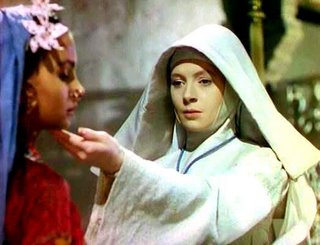
Throughout her career, Miss Kerr worked at being unpredictable. She was believable as a steadfast nun in Black Narcissus; as the love-hungry wife of an empty-headed army captain stationed at Pearl Harbor in “From Here to Eternity”; as a headmaster’s spouse who sleeps with an 18-year-old student to prove to him that he is a man in “Tea and Sympathy”; as a spunky schoolmarm not afraid to joust and dance with the King of Siam in “The King and I”; as a Salvation Army lass in “Major Barbara”; and even as Portia, the Roman matron married to Brutus, in Shakespeare’s “Julius Caesar.”
She could be virginal, ethereal, gossamer and fragile, or earthy, spicy and suggestive, and sometimes she managed to display all her skills at the same time.
Miss Kerr made “From Here to Eternity” even though Harry Cohn, chief of Columbia Pictures in that era, had wanted Joan Crawford in the part and had to be persuaded to accept Miss Kerr. She regarded the role as the high point in her climb to stardom in the United States, and it yielded her second Academy Award nomination.
Andrew Breitbart and David Ehrenstein are doing a point/counterpoint thing at the LA Times. In Part 1, they tackle upcoming war flicks. In Part 2, they tackle Hollywood's role as opinion maker.
Breitbart proposes (facetiously?) a very unconservative state-funded campaign to promote political diversity.
Let's promote the "diversity education" notion that has made American higher education the gold standard around the world. But instead of race, gender and sexuality as the dominant precepts, our creative coaltion will focus on differing ideas -- left, center AND right. Think of that "fairness doctrine" some of your allies have been bandying about.
Fair?
It won't be about "identity" politics; it will be about American politics. It will be a publicly funded national artistic reunification project -- like something FDR would've implemented -- where Tim Robbins and his common-law wife will actually get to hear the other side. Maybe she'll even take off her shirt like she does in all her movies. But this time it will be for America!
Sounds like a recipe for very bad films.
Ehrenstein says Hollywood was never any good at propaganda, anyway, and then brings up two films by the same director, the first of which was pro-Soviet and the second of which was anti-Soviet.
Let's jump into the Wayback Machine and return to the early 1940s, when the Soviet Union was America's ally (yes, you read that right), and Hollywood was devoted to creating fanciful melodramas of its brave efforts to counter the Nazi menace. One of them was "Days of Glory" (1944), directed by Jacques Tourneur, and starring prima ballerina Tamara Toumanova and (in his motion picture debut) Gregory Peck. The script by Melchior Lengyel (a Hungarian emigre who co-scripted "To Be or Not to Be" and "Ninotchka" for Ernst Lubitsch) and Casey Robinson (a veteran screenwriter whose most famous titles are "Now, Voyager" and "Kings Row") is a fairly standard action-and-romance presenting Russian villagers as really nice people who don't deserve to be attacked by Hitler's armies. Nothing teribly special about it, other than Peck's obvious star potential.
As you might expect, a film like this looked a lot different by the war's end, when the U.S.-Soviet alliance was not only over but being treated as if it never happened, to judge from testimony given by numerous stars and studio chiefs before the House Un-American Activities Committee. This decidedly Orwellian turn of events (sorry, but no other word applies) was made complete by the 1950s with the "Cold War" in full swing. By 1958, "Days of Glory" director Jacques Tourneur could be found at the helm of "The Fearmakers" -- a bizarre little number in which Dana Andrews undoes a plot by evil commies Mel Torme and Veda Ann Borg to create biased opinion polls, the better to influence the media and elections. Interestingly enough, the script was based on an anti-Nazi World War II era novel by Darwin L. Teilhet. With a tap of the typewriter Nazis became commies thanks to scripters Chris Appley (this remains his sole credit to date) and TV veteran Elliot West -- whose works include "Airwolf" and "Lou Grant," starring noted lefty Edward Asner. Yes, Hollywood makes strange bedfellows.
This has nothing to do with anything, except perhaps to illustrate that Hollywood was sensitive to (or perhaps agreed with) the majority of Americans who welcomed Soviet help during World War II but didn't much like the Soviets in 1958, a mere two years after Soviet tanks rolled into Hungary. As Lord Palmerston observed: “Nations have no permanent friends or allies, they only have permanent interests.”
There is a tendency among conservatives to unfavorably compare World War II-era movies to the movies of today. But the world has changed since 1945. Aside from the fact that World War II received almost unanimous support from the American people--which is hardly the case now--most everyone in the country was affected in some way by the war. Most people knew someone serving overseas. And the people left at home were rationing gas, recycling tinfoil, painting seams on their legs to give the illusion of stockings and working in defense plants. Now millions of us don't know any servicemen or women. And we certainly aren't rationing anything.
Still, it's alarming that not one of this fall's so-called war films can be considered pro-war--or even any that are war-neutral. Most of these movies don't even, as the left is wont to say, support the troops since the troops depicted are likely depicted as murderous rapists.
I'm not saying that filmmakers shouldn't make a movie about a murderous raping soldier, but how about a movie about a guy serving in Iraq who's not a murderous rapist? He doesn't have to be a saint, either. Just a normal guy. Or gal. Or how about a movie about a battle in Iraq or Afghanistan, real or fictional, that doesn't even discuss the war's rightness or wrongness?
I'm redoing my resume while attempting to watch a Roz Russell film festival on TCM. Naturally, I'm enjoying the latter much more than the former though I can't say I've really been able to devote the kind of concentration to Ms. Russell that I would have liked. Which is a pity because they've shown a number of movies that I've never seen before. And my DVR is broken so I can't save them for later.
I do think, however, that my resume is much better than it was before. It's punchier and chock-full of those action verbs prospective employers are said to like so much.
TCM ran a Myrna Loy marathon yesterday, starting with all of the Thin Man and ending with The Bachelor and the Bobby Soxer. Absolute heaven. The first video below is a series of clips from the Thin Man movies. It's followed by Myrna's most memorable scene from Mr. Blandings Builds His Dream House, which was not shown last night.
I see Cate Blanchett will be playing Elizabeth I again in the upcoming Elizabeth, The Golden Age. This comes on the heels of Helen Mirren's HBO series and Showtime's series, "The Tudors," which is actually about Henry VIII, Elizabeth's father.
I haven't seen either of those shows, but will probably do so eventually--though I've got to say that the guy playing Henry VIII looks a little too lean and dark for the part. (This review says the actor is better suited to play "a scheming courtier or pining poet than an extroverted royal peacock.") But I do like me some Tudors, especially Elizabeth.
I saw Blanchett's first Elizabeth film and liked it very much. It wasn't exactly historically accurate, but that doesn't bother me overmuch. Elizabeth was such a fascinating character that I always find it interesting to see how others view her. Though I hold no truck with those who sympathize with Mary, Queen of Scotts. Mary Stuart was a royal pain in the ass and Elizabeth allowed her to stick around for far too long. The new movie, I see, will touch on that. Here's the trailer:
And here, just for kicks, is a rundown of movies about Elizabeth with pictures.
As it happens, I'm enjoying an Elizabethan renaissance myself. I've been watching "Elizabeth R," the BBC series starring Glenda Jackson, who really embodies Elizabeth--in my humble opinion. I first watched the series a gazillion years ago when it first aired on "Masterpiece Theater." I loved it then and kind of wondered how it held up. It did. Jackson is superb, as is the supporting cast, the costumes are terrific and the makeup is great. Here are some photos of Jackson being made up as Elizabeth.
I'm also reading Paul Johnson's book, Elizabeth I: A Study in Power and Intellect, which was published in 1974 before, I think, Johnson became famous over here. It's not really an authoritative biography-Johnson skips around a lot, which can get kind of confusing--but I'm enjoying it. I like Johnson's brisk style. And I like that he quotes a lot from primary sources. He portrays Elizabeth as a conservative who, though desperate for cash, was reluctant to raise money through taxes.
It was not a method of raising money she exploited but rather, to her mind, a monarchical privilege which was to be used sparingly. Direct taxation cost her popularity, and employing it had therefore to be balanced against the necessity to furnish the Exchequer. She was as reluctant to raise money as to spend it. Whenever possible, she turned to other methods. ... In 1591 there was a more bizarre effort: negotiations with Edward Kelly, a medium ... [who] had been experimenting in the transmutation of base metal into gold ... ELizabeth was skepical of Kelly's powers, but determined, if they existed, that they should be used in the service of England ...
If sometimes, as Ralegh complained, she underfinanced her war policies, she maintained political solidarity and economic expansion by keeping the English the lowest-taxed nation in Europe, a fact to which Bacon paid tribute: 'He that shall look into other countries and consider the taxes, and tallages, and impositions, and assizes and the like that are everywhere in use, will find that the Englishman is most master of his own valuation and the least bitten in purse of any nation in Europe.'
But Elizabeth was no neocon; she didn't seek out war, but was forced into it by circumstances, as when she--after much prodding by her advisors--sent then-favorite Robert Dudley, Earl of Leicester to the low countries to defend Protestant interests. War could be very expensive.
Even by the somewhat bizarre standards of sixteenth-century warfare, Leicester's personal entourage gave his army a top-heavy appearance. We possess a list of over 1,100 persons forming what was called his 'train'. ... Moreover, Leicester himself was surrounded by a household a monarch might have envied: his personal suite comprised 99 gentlemen-officers, yeomen and their servants and over 70 lords, knights and gentlemen; he had a steward, 4 secretaries, 2 engineers, pages, grooms, trumpeters, footmen, chaplains, physicians and a whole company of actors. The vast quantities of baggage included no less than 44 beds for the kitchen staff alone.
That's how Terry Teachout sees the work of Ingmar Bergman and I must say I agree, which is why I didn't bother posting about his death earlier. Then I read this column.
Bergman is one of a large category of “important artists” whose defining quality is an almost total absence of public acclamation or popularity. Every art form has its equivalent – think James Joyce or Sir Harrison Birtwistle – but cinema is exceptional in its preponderance of such “important artists”. The latest is Lars von Trier, a maker of terminally dull films that are, nonetheless, lauded by cineastes (they have their own word, signifying that they’re a cut above bog-standard moviegoers).
...
But much as I think Bergman is overrated, I hold only one thing against him: ruining Woody Allen. Somewhat bizarrely, Allen has long revered Bergman and made a series of films – September, Another Woman and Shadows and Fog – modelled on Bergman’s style. And although he has made some decent films since, Allen’s decline started with the Bergman hommage films. And for that the Swedish director can never be forgiven.
Yes. Yes. Yes. I started souring on both of them when I saw Interiors. It came out nearly 30 years ago and I saw it in the theater. I still regard the time spent there as among the worst two hours in my life.
Just a feeling I have. I can't remember when I've seen something so relentlessly promoted, which is usually a bad sign. Plus, it's been 17 years, or something like that, in the making. I'd be perfectly happy to be proved wrong, however.