Showing posts with label Jane Austen. Show all posts

Apr 5, 2007

Diagnosing Mr. Darcy

According to a new critical study, the hero of Pride and Prejudice had Asperger's syndrome.
Jane Austen is apparently not alone in unwittingly describing autism in her novels. Characters as diverse as the monster from Mary Shelley's Frankenstein to Sherlock Holmes have been placed on the autistic spectrum. Does this help us understand the books better? I'm afraid not - having a neat medical tick box in which to place a character and understand them detracts from, rather than adds to, what the story is trying to tell us. The most obvious example of this is Herman Melville's Bartleby. The pallid scrivener's eccentric behaviour in Melville's eponymous novella has given rise to critical speculation - most recently in a 2004 MLA paper - that the character is an "autistic presence". You can see why Bartleby's strange, persistent behaviour and refusals - "I would prefer not to" - suggests autism. And yet, at the risk of sounding heartless, it matters not one jot to the story if Bartleby is or is not autistic. Bartleby, as much as his strangeness and remoteness engages us, is just a cipher in this story. As the title itself tells us Bartleby the Scrivener is not the story of a man but A Story of Wall Street. This is a story about a society that alienates as much as it is a story about an individual who is alienated.

Actually, I thought Bartleby had OCD.

Mar 23, 2007

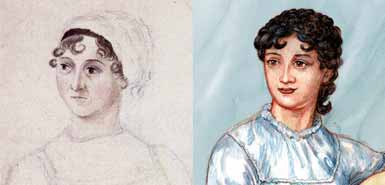
Jane Austen gets a makeover

jane-austin385_151946a


Publisher gives Jane an upgrade to boost sales.
Helen Trayler, its managing director, said: “The poor old thing didn’t have anything going for her in the way of looks. Her original portrait is very, very dowdy. It wouldn’t be appealing to readers, so I took it upon myself to commission a new picture of her.

“We’ve given her a bit of a makeover, with make-up and some hair extensions and removed her nightcap. Now she looks great — as if she’s just walked out of a salon.”
Background

The only contemporary portrait of Austen is a sour-faced sketch by her sister Cassandra that hangs in the National Portrait Gallery. But the author’s friends and family described her as “very attractive” and “like a doll”, and a niece, Anna, said that Cassandra’s depiction of Jane was “hideously unlike” her.
I see they've boosted Jane's lips with collagen, but I can't tell whether she's undergone breast augmentation.

Mar 16, 2007

Annotating Jane Austen

William Grimes writes about the growing market for annotated books and period guides to Austen's work.
Furze is a plant found all over England. It covers Egdon Heath, the forbidding wasteland in Thomas Hardy’s “Return of the Native,” and when I first read the novel, many years ago, I conjured up a vivid and completely inaccurate picture of what it looked like. I envisioned furze as a tangle of bare, black and gnarled stalks — a bonsai version of the leafless evil trees in Walt Disney’s “Snow White.” In fact furze is the same plant as gorse, the yellow-flowered shrub that Winnie-the-Pooh falls into. My reading was factually false but imaginatively true to the spirit of Hardy’s bleak, oppressive landscape.
This sort of thing is fun, but hardly necessary. When I was a child, reading about someone tucking into plum pudding, I envisioned something luscious and exotic--the ultimate festive treat. Knowing that plum pudding is a revolting sort of a steamed fruitcake would have--for me--made the festivities in A Christmas Carol much less tantalizing.

Turkish Delight, the candy given to Edmund in The Lion, the Witch and the Wardrobe, is rather delightful. And knowing now about wartime sugar rations during the period makes Edmund's seduction by candy all the more understandable for me the adult reader. But as a child just the name Turkish Delight conjured up something magical and alluring. Clearly, it was a treat that would require massive willpower to resist.

I also find annotated editions distracting.
Do details like this matter? The question posed itself, again and again, as I read “The Annotated Pride and Prejudice,” published this month. David M. Shapard, the editor, does not merely sprinkle a few footnotes here and there. Each and every page of Jane Austen’s text has a facing page of explanatory notes, more than 2,300 of them all told. Some are as brief as a word or two; others amount to small essays. No one, working diligently through novel and notes, will ever fall victim to what I now think of as the furze fallacy.
I have a complete works of Shakespeare that's annotated up the wazoo. But if I actually want to read a play, I prefer to consult a paperback. Not only is the complete works too heavy to read in bed, but I find myself stopping to read each note on the page, whether it's a definition of "Alarum" or a treatise on the War of the Roses. Still, it's a fun thing to have as an extra.

Mar 12, 2007

In praise of Jane

Austen, that is.
One version of the Austen scenario holds that it is all about stalking and bringing down your man, but Jane Austen is not the editor of Cosmopolitan. The point is not to achieve the man at any cost. He is not the prey or the prize but the symbol of merit. The possibility that there may be no such man is always present. Part of our gratified surprise at the Austen happy ending is that there was a man around with the good sense to see that a woman without rich and powerful connections might be a pearl beyond price, a woman whose company was reward in itself. We know that she is good company because we have been seeing the world through her disabused eyes. We go on reading and watching Jane Austen because she is good for us.